


Sample IRS Audit Letters You Might Receive and How To Respond
Updated for 2026
Quick Summary
An IRS audit letter is a mailed notice from the IRS telling you that a tax return has been selected for review or that the IRS needs more information before it can accept part of your return. The letter should identify the tax year, the issue being questioned, the documents requested, the deadline to respond, and the IRS office or examiner handling the matter.
If you receive an IRS audit letter, do not ignore it. Read the notice carefully, identify the exact letter or notice number, check the response deadline, gather the documents requested, and respond completely. If the letter involves a large proposed balance, business deductions, missing income, a meeting with the IRS, or anything you do not fully understand, speak with a tax attorney before sending a response.
If you receive any IRS letter, it is important to respond in a timely and detailed manner. Most IRS letters ask you to verify basic information about dependents, itemized deductions, unreported income, eligibility for credits, business deductions, or filing status.
Just because you received an IRS certified letter does not always mean you are being audited. But IRS audits can be serious, and if you have received an audit letter, it is important to know what type of notice you received and what the IRS is asking you to do.
What do IRS audit letters look like, and when does the IRS send audit letters? There are several forms that IRS audit letters might take, several reasons the IRS sends them, and certain details you need to check before responding.
If you are not sure what your IRS letter means or how to respond, an experienced tax lawyer can help you understand the notice, prepare the response, and deal with the IRS directly.
Some taxpayers are also receiving notices tied to Employee Retention Credit claims. If your business is facing an ERC audit, an IRS audit attorney can help you review the claim, respond to the IRS, and reduce the risk of making the problem worse with an incomplete or inaccurate response.
How To Know Whether Your IRS Letter Is An Audit Letter
The IRS says that if your account is selected for audit, it will notify you by mail. The IRS does not initiate an audit by telephone, and it will not start an audit by email.
An IRS audit letter will usually include:
- Your name
- Your tax ID number or Social Security number
- Your address and contact information
- The tax year being examined
- The issue or items the IRS is questioning
- The documents the IRS wants you to provide
- The response deadline
- The IRS address, fax number, upload option, or examiner contact information for your response
Typically, an IRS audit letter will say that a tax return from a specific year has been selected for examination or that additional information is needed before the IRS can verify items on your return.
The IRS may handle an audit by mail or through an in-person interview. A mail audit is often called a correspondence audit. An interview at an IRS office is known as an office audit. An interview at your home, place of business, or representative’s office is known as a field audit.
Common IRS Audit Letters and Notices
If you are wondering, “What does an audit letter from the IRS look like?” start by identifying the notice or letter number. Here are common examples taxpayers may receive:
| IRS letter or notice | What it usually means | Is it an audit? | What to do next |
|---|---|---|---|
| Letter 566 or correspondence audit letter | The IRS is asking for documents or explanations to support items on your return, such as business income, expenses, deductions, credits, or filing status. | Yes. This is commonly used in correspondence audits. | Review every item requested, gather supporting documents, prepare a complete written response, and send it by the deadline listed in the letter. |
| Notice of Audit Meeting | The IRS wants to meet with you or your representative to review your return and discuss the items being questioned. | Yes. This may involve an office audit or field audit. | Do not attend unprepared. Review the return, organize records, and consider having a tax attorney represent you at the meeting. |
| CP2000 notice | The IRS received income or payment information from third parties that does not match what was reported on your tax return. | Not exactly. The IRS says a CP2000 is a proposed change and is not a bill, but your response may be required. | Compare the IRS information against your records. If you agree, follow the notice instructions. If you disagree, send the response form and supporting documentation. |
| Notice of Deficiency | The IRS is formally proposing additional tax and giving you a limited period to petition the U.S. Tax Court. | It may follow an audit or unresolved examination issue. | Act immediately. The IRS says it cannot extend the time to petition the U.S. Tax Court beyond the original 90 days. |
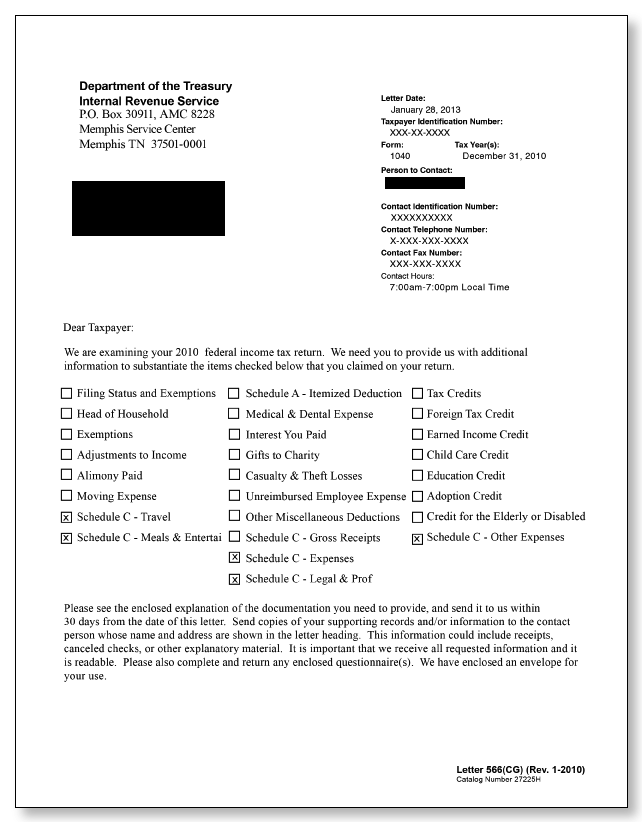
Sample IRS Audit Letter: Letter 566
A sample IRS audit letter, sometimes called an IRS correspondence letter, asks for additional information to support claims within a certain section or sections of your tax return for a given year.
For example, a Letter 566 may refer to items on Schedule C, which reports profit or loss from a business. It is common for the IRS to question business deductions taken by small business owners and sole proprietors.
Sample Notice of Audit Meeting
A Notice of Audit Meeting is an invitation to meet with an IRS official to review your tax return and discuss the items the IRS is questioning. You may attend on your own, attend with your spouse if it is a joint return, or have a qualified tax attorney represent you.
If you receive a meeting notice, preparation matters. The IRS meeting is not just a conversation. It is part of an examination process, and what you provide, say, or fail to explain can affect the outcome.
Sample IRS Letter CP2000
You may receive an IRS CP2000 notice when the IRS proposes changes to your tax return based on information it received from third parties, such as employers, banks, financial institutions, brokerage firms, or payment platforms.
A CP2000 notice may say that income or payment information the IRS received does not match what you reported on your tax return. The notice should explain the information the IRS used and give you an opportunity to agree or disagree with the proposed changes.
The IRS states that a CP2000 notice is not a bill. But that does not mean you can ignore it. If you do not reply or the issue is not resolved, the IRS may send another notice and a bill.
How To Respond To An IRS Audit Letter
Every IRS audit is different, but the response process should be organized and deliberate. A rushed or incomplete answer can create more problems than it solves.
- Identify the notice or letter number. Look for the IRS letter number, notice number, tax year, and response deadline.
- Confirm what the IRS is questioning. Do not assume the IRS is questioning your entire return. The letter may focus on specific deductions, credits, income items, business expenses, or filing status.
- Check the deadline. The date on the notice matters. If you need more time for a mail audit, the IRS says you may request an extension, but certain notices, including a Notice of Deficiency, have deadlines that cannot be extended.
- Gather the exact documents requested. Do not send random records. Match your documents to each issue listed in the IRS letter.
- Prepare a clear written explanation. Your response should explain what each document proves and how it relates to the tax return item being questioned.
- Decide whether you agree or disagree. If the IRS proposes a change, your response should clearly state whether you agree, partially agree, or disagree.
- Keep proof of delivery. The IRS recommends using a delivery method that confirms receipt. Keep a complete copy of everything you send.
- Get help before the deadline if the issue is serious. If the notice involves a large proposed balance, business records, foreign accounts, payroll taxes, ERC claims, or a meeting with an IRS examiner, get professional advice before responding.
Finding and Sending Required Documentation for An IRS Audit
The documents you need to send depend on the reason for the audit and the issues listed in the IRS letter. The IRS may ask for records connected to income, expenses, deductions, credits, dependents, business activity, or other return items.
Documentation may include:
- Receipts
- Canceled checks
- Bank statements
- Credit card statements
- Business mileage logs
- Invoices
- Loan agreements
- Employment documents
- Medical records
- Appraisals
- Forms W-2, 1099, 1098, or similar income records
Your IRS audit letter may also ask you to explain the facts surrounding your tax filing. If you do not have all the records requested, you may need to contact banks, employers, charities, vendors, accountants, or other third parties for copies.
Do not ignore missing records. If records are unavailable, your response should explain what is missing, why it is missing, and what alternative documentation you are providing.
Tips For Writing Your IRS Audit Response Letter
You may write your audit response letter yourself, or you may hire a tax attorney to prepare it for you. The right choice depends on the notice, the amount at stake, the complexity of the records, and whether the IRS is asking for a meeting or proposing additional tax.
To ensure accuracy and completeness, a skilled DMV area IRS tax lawyer like Attorney Sammy Kim can help draft your IRS audit response letter, respond to a CP2000 notice, and represent you in IRS audit proceedings.
How To Write The IRS A Letter
If you write a letter to the IRS yourself, include the basic information the IRS needs to identify your file:
- Your full name
- Your tax ID number or Social Security number
- Your contact information
- Your business name and business ID, if applicable
- The tax year at issue
- The IRS notice or letter number
- The name of the IRS officer or examiner assigned to your case, if listed
- A clear statement of whether you agree or disagree
- A list of documents attached to your response
In your audit response letter, address every issue listed in the IRS audit letter. The IRS pays close attention to completeness. An incomplete response can lead to delays, proposed adjustments, or additional notices.
Attach the related documentation before sending the letter. Double check the deadline, mailing address, fax number, or upload instructions listed in the notice.
When Should You Contact A Tax Attorney About An IRS Audit Letter?
You should consider contacting a tax attorney before responding if:
- The IRS is proposing a large tax increase
- The notice involves business income or deductions
- The IRS is asking for an in-person meeting
- You received a Notice of Deficiency
- You disagree with the IRS but are not sure how to prove your position
- You are missing records
- The audit involves payroll taxes, foreign accounts, ERC claims, or multiple tax years
- You are worried that your response could create additional exposure
Taxpayers have the right to retain representation when dealing with the IRS. You also have the right to challenge the IRS’s position, provide documentation, appeal many IRS decisions, and pay no more than the correct amount of tax.
Sammy Kim is the founder and principal attorney of the Law Offices of Sammy Kim in Fairfax, Virginia. She focuses exclusively on resolving IRS and state tax problems for individuals and businesses. She holds an LLM in Taxation from Georgetown University Law Center, is admitted to the U.S. Tax Court, and represents clients in Northern Virginia, Washington, DC, and nationwide for federal IRS matters.
IRS Audit Letter FAQ
Does the IRS send audit letters by certified mail?
The IRS notifies taxpayers of audits by mail. Some important IRS notices may arrive by certified mail, especially notices involving formal deadlines. The most important point is that an IRS audit does not begin by email or by an unsolicited phone call.
Can the IRS audit you by email?
No. The IRS says it will notify you by mail if your account is selected for audit. Be very careful with emails, texts, or phone calls claiming to start an IRS audit.
Is a CP2000 notice an audit?
A CP2000 notice is not exactly the same as a traditional audit. It is a proposed change based on a mismatch between your tax return and information the IRS received from third parties. The IRS says a CP2000 notice is not a bill, but your response may be required.
What happens if I ignore an IRS audit letter?
If you do not respond by the date shown on the IRS letter or notice, the IRS may complete the audit and send an audit report with proposed changes to your tax return. Ignoring the letter can make it harder to protect your position later.
How long do I have to respond to an IRS audit letter?
The deadline depends on the letter. Always use the date printed on your notice. For some mail audits, the IRS may grant a one-time extension if requested properly. But if you receive a Notice of Deficiency, the IRS says it cannot extend the time to petition the U.S. Tax Court beyond the original 90 days.
What documents should I send with an IRS audit response?
Send documents that directly support the items the IRS is questioning. These may include receipts, canceled checks, bank statements, invoices, mileage logs, employment records, loan documents, or other records listed in the notice. Keep copies of everything you send.
Should I respond to the IRS myself or hire a tax attorney?
If the issue is simple and you have complete records, you may be able to respond yourself. If the notice involves a large balance, missing income, business deductions, a meeting with the IRS, payroll taxes, foreign accounts, ERC claims, or a deadline you do not understand, it is safer to speak with a tax attorney first.
Can a tax attorney talk to the IRS for me?
Yes. The IRS allows taxpayers to authorize a qualified representative to contact the IRS on their behalf. This is usually done with IRS Form 2848, Power of Attorney and Declaration of Representative.
Talk To A Tax Attorney About Your IRS Audit Letter
If you received an IRS audit letter, CP2000 notice, Notice of Audit Meeting, or Notice of Deficiency, do not wait until the deadline is close. The earlier you understand the notice, the more options you may have.
Talk to a tax expert now. Book a consultation at vataxattorney.com or call (703) 202-1005.

On Behalf of the Law Offices of Sammy Kim
IRS and State Tax Lawyer
The Law Offices of Sammy Kim helps clients handle tax issues with the federal or state tax authorities, including negotiating offers in compromise and installment agreements, reducing or eliminating tax debt, releasing wage levies, business bank levies, and tax liens, and relieving tax penalties for failure to pay.
Your IRS Tax Problem Has a Solution
That’s Right For You
More Tax Lawyer Tips

IRS Notice Of Intent To Levy: What To Do Before The Deadline
By On Behalf of the Law Offices of Sammy Kim |
